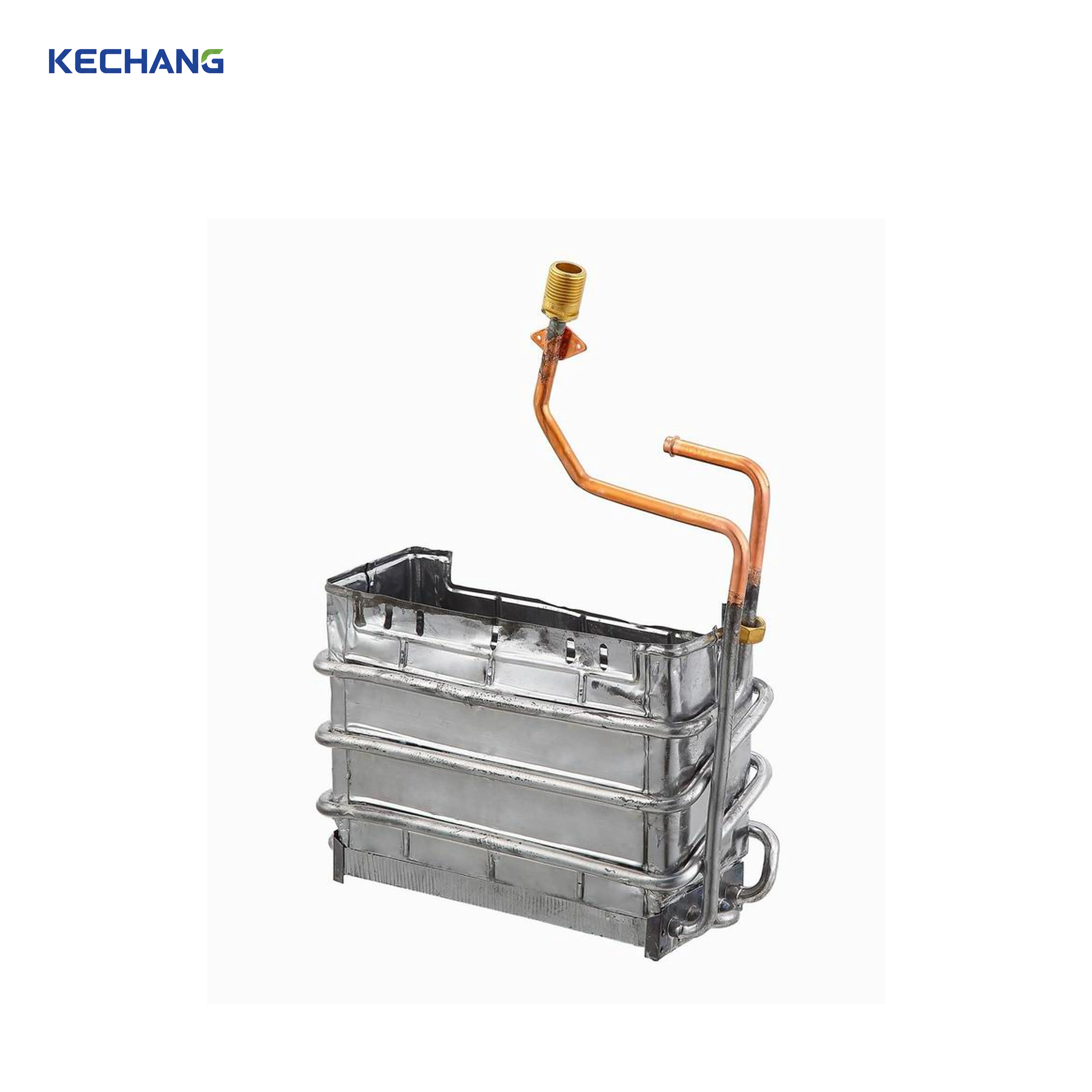
The copper heat exchanger is one of the most important parts of a tankless gas water heater. It transfers heat from the burner to the water and directly affects heating performance, durability and safety.
However, a heavier heat exchanger is not always better. The correct design must match copper tube thickness, heat-transfer area, water flow, burner input, gas type and application.
What Is the Copper Tube in a Gas Water Heater?
In an instant gas water heater, cold water flows through copper tubes while the burner heats the outside of the tubes. The heated water then flows to the outlet.
This system is used in a natural gas water heater, butane gas water heater, LPG model and wall mounted gas water heater. It is also known as a tankless gas water heater, gas water heater on demand or continuous flow gas water heater.
A complete heat exchanger assembly normally includes:
- Copper tubes or coils
- Water inlet and outlet connections
- Headers and joints
- Fins or heat-transfer plates
- Welding points
- Mounting brackets
You can review different OEM heat exchanger assemblies in our 6L–20L wholesale gas water heater heat exchanger product range.
How Thick Are Gas Water Heater Copper Tubes?
There is no single copper tube thickness that fits every gas water heater. Thickness depends on the model, water pressure, heat input, copper material, tube diameter and required service life.
Some market references use approximately 0.8 mm or 1.2 mm wall thickness as design examples. These values should not be treated as universal industry standards. Buyers should request the actual technical drawing and material specification for each model.
The Chinese gas appliance standard requires heat exchanger copper tube wall thickness to comply with the applicable copper tube requirements rather than using one universal value. See the T/GGAA 001—2021 standard amendment.
For example, this 6L copper heat exchanger with an indicated 0.8 kg assembly weight can be compared with larger 6L designs according to their actual specifications.
Thin vs Thick Copper Tubes: What Is the Difference?
Pressure and leakage resistance
A thicker tube can provide a greater material allowance against pressure, erosion and repeated thermal expansion. However, leakage also depends on welding, joints, corrosion, water quality and pressure testing.
A thick tube with poor welding is not automatically safer than a correctly designed thinner tube.
Thermal stress and service life
Every ignition and shutdown cycle creates temperature changes in the heat exchanger. If the copper tube or drum is too thin for the operating conditions, repeated thermal stress may increase deformation and fatigue.
This is especially important for products used frequently, in commercial applications or in areas with hard water and unstable water pressure.
Heat-transfer performance
Copper transfers heat efficiently, but thicker does not automatically mean faster heating. Heat-transfer performance also depends on:
- Total heat-transfer area
- Tube length and diameter
- Burner flame coverage
- Water flow rate
- Fin design
- Flue gas movement
- Scale buildup
- Longer or larger copper tubes
- More heat-transfer surface
- Stronger headers and connections
- A higher-input burner
- More advanced water and gas controls
- Greater resistance to thermal cycling
- Copper material and tube wall thickness
- Heat exchanger assembly weight
- Rated water flow
- Gas input and gas type
- Pressure-test records
- Leak-test and combustion-test results
- Installation instructions
- Spare-parts availability
Why Do Different Heat Exchanger Weights Use Different Tube Thicknesses?
Different models require different designs. A 6L unit for one shower does not need the same heat-transfer area or burner input as a 16L or 20L unit for multiple outlets.
A larger model may require:
Our forced and balanced gas water heater heat exchanger range shows why the same capacity range may use different heat exchanger structures according to the flue system and product design. Buyers can also compare the flue-type gas water heater collection.
Is a Heavier Heat Exchanger Always Better?
No. Heat exchanger weight may come from copper tubes, headers, fins, brackets or other components. Weight alone cannot prove quality.
An overly heavy design may increase material cost, gas water heater cost, shipping cost, installation difficulty, thermal inertia and production complexity.
Does the heat exchanger match the burner, water flow, pressure, gas type and target market?
This is important when comparing the price of gas water heater models, gas water heater replacement cost and electric vs gas water heater options.
How Does the Burner Match the Heat Exchanger?
The burner must provide enough heat for the water flow and required temperature rise.
If the burner is too small, water may not become hot enough, the rated capacity may not be achieved, temperature may fall when several outlets operate, and the gas water heater may appear not to be working correctly.
If the burner is too large, the copper tube may experience local overheating, scale may form faster, overheat protection may activate, and combustion and exhaust control become more difficult.
A reliable gas water heater should therefore use a matched burner, heat exchanger and control system rather than simply adding more copper or more flame.
Maintenance and Buying Checks
Before purchasing gas water heaters for domestic use or gas water heaters for home use, ask the supplier for:
You can also review our gas water heater spare parts collection before placing an OEM order.
For safe operation, follow the installation manual and arrange professional gas water heater maintenance. Search topics such as how to flush a gas water heater, how to drain sediment from a gas water heater and how to maintain a gas water heater, but do not disassemble gas components without a qualified technician.
If you notice a gas smell when the water heater turns on, repeated shutdowns or unusual noise, turn off the appliance and contact a qualified service professional. Do not continue using it until the cause is confirmed.
Frequently Asked Questions
Does a heavier copper heat exchanger mean better quality?
Not necessarily. Weight may come from copper tubes, headers, fins, brackets or other components. Quality also depends on copper material, tube thickness, welding, pressure testing, heat-transfer design and burner matching.
What copper tube thickness is best for a gas water heater?
There is no universal best thickness. The correct thickness depends on tube diameter, water pressure, burner input, water flow, copper material and required service life. Buyers should request model-specific technical drawings instead of judging quality by thickness alone.
Does copper tube thickness affect heating speed?
It can affect thermal response, but it is not the only factor. Heating speed also depends on burner input, heat-transfer area, water flow, inlet-water temperature, tube design and scale buildup.
How does burner input affect water temperature?
A burner that is too small may not provide enough heat at high water flow. A burner that is too large may cause local overheating, faster scale formation or frequent activation of overheat protection. The burner and heat exchanger must be designed as a matched system.
Is a 16L gas water heater always better than a 10L model?
No. A 16L model can supply more hot water under rated test conditions, but a 10L model may be more suitable for one shower, a small apartment or a low-demand application. The correct capacity depends on the number of outlets, temperature rise, water pressure and local climate.