Gas water heaters from a China factory can offer competitive pricing, flexible OEM production, and scalable supply for importers, distributors, private-label brands, contractors, and project buyers. The safest way to source is to compare the complete supply capability—not just the lowest quotation. Product specifications, fuel configuration, factory quality control, testing, packaging, delivery, and after-sales support should be reviewed together.
1. Gas Water Heaters from a China Factory: Market and Product Requirements
Before contacting suppliers, prepare a clear product brief. Include the destination country, application, gas type, installation environment, expected annual volume, target capacity, water-pressure range, voltage or battery requirements, exhaust configuration, packaging, branding, and required documents.
- Natural gas, LPG, or a specified local fuel configuration.
- Indoor, outdoor, flue-exhaust, or balanced-flue installation.
- Residential, commercial, hotel, apartment, or project use.
- Tankless flow rate and required temperature rise.
- OEM, ODM, private-label, carton, nameplate, and language requirements.
For gas water heaters from a China factory, a detailed brief helps every supplier quote the same product. It also prevents a factory from offering a low price for a model that does not meet the target market’s installation or performance requirements.
2. Gas Water Heaters from a China Factory: Verify Production Capability
Ask whether the company is the manufacturer, a trading company, or a combination of factory and export office. Request a company profile, production address, product categories, years of operation, production capacity, quality-control process, and export experience.
Useful evidence includes a factory video call, production-line photographs, sample-room review, product-development capability, and clear answers about testing and warranty handling. Do not rely on a marketplace badge or a generic “manufacturer” label alone.
For quality-management context, buyers can review the principles described in the ISO 9001 quality-management overview. Certification does not replace product testing, but it can help buyers ask better process-control questions.
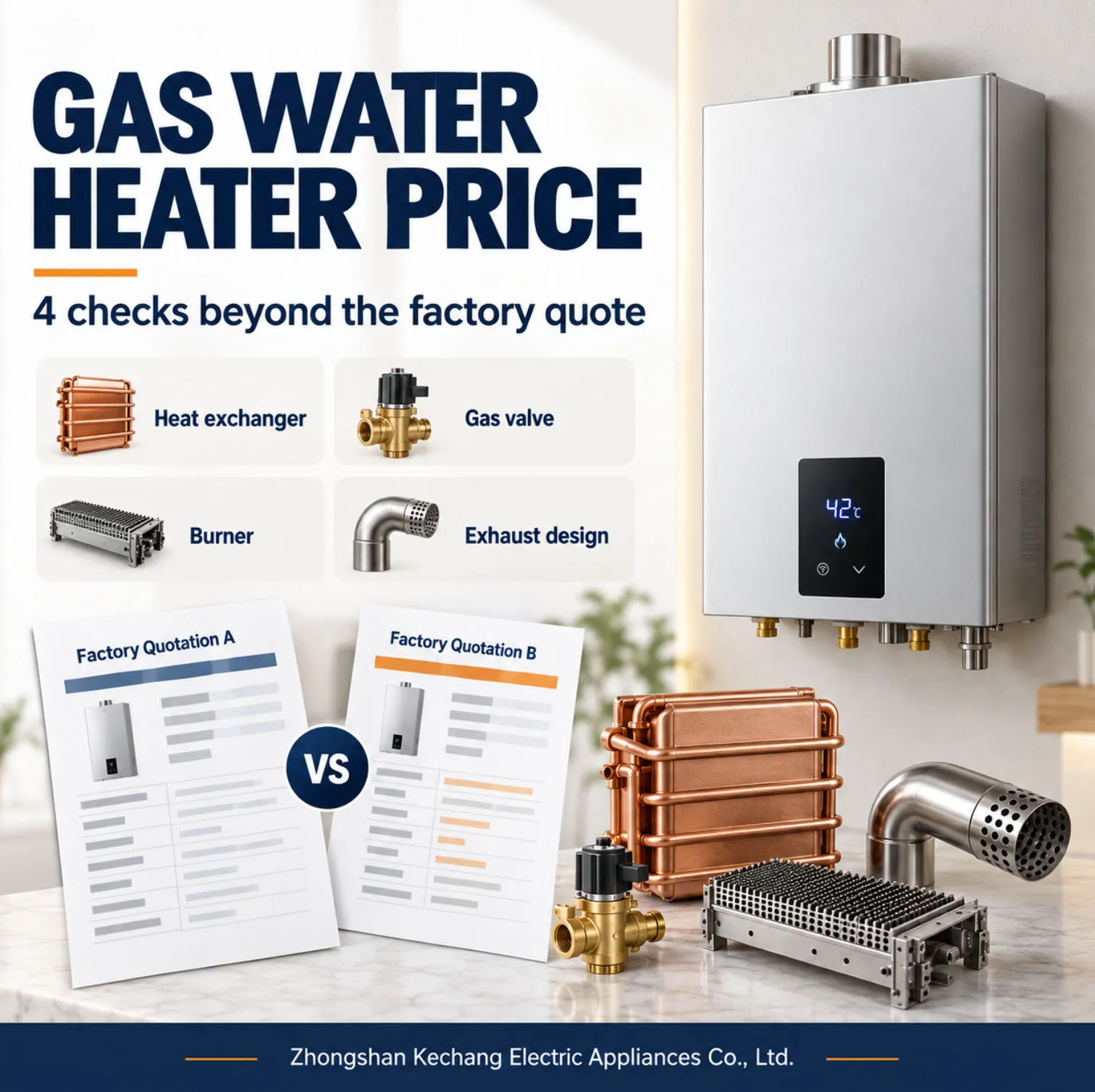
Four Checks Before Approving a Factory
Verify the Production Site
Match the legal business name and production address to the facility shown during a live tour. Review the factory tour and request a current, model-relevant walkthrough.
Approve One Exact Sample
Record its gas configuration, heat exchanger, burner, controls, rating plate, manual and packaging. Keep photographs and an approved specification sheet with the purchase order.
Ask for Process Evidence
Review how incoming components, gas and water circuits, ignition, temperature stability and final labels are checked for the selected model. Confirm which checks are made on every unit and which use sampling. See our Quality Control page for the inspection approach.
Define Change Control
Require written approval before substituting a component, material, label or packing item after the sample is approved. Record the agreed branding and packing details in the OEM/ODM specification.
3. Compare specifications and fuel configuration
Compare technical data line by line. A gas water heater’s capacity should be stated with a flow rate and temperature-rise condition. Review thermal efficiency, rated heat load, minimum start-up pressure, maximum working pressure, heat-exchanger material, ignition method, protection functions, dimensions, and connection sizes.
For LPG and natural-gas versions, confirm the rating plate, burner configuration, gas inlet pressure, regulator requirements, and approved conversion procedure. Never assume that a natural-gas model can be converted to LPG without the correct parts and professional commissioning.
- Check flame-out, anti-dry-combustion, over-temperature, and over-pressure protection.
- Confirm whether low-pressure start-up or freeze protection is optional.
- Review LCD display, winter-summer switch, valve, heat-exchanger, and panel options.
- Ask for installation drawings and a complete user manual before bulk production.
4. Check quality control and sample testing
Request a production sample before approving a large order. Test ignition, water-flow activation, temperature stability, shutdown response, gas compatibility, packaging, and visible assembly quality under conditions that match the destination market.
Ask the supplier to explain incoming-material inspection, assembly checks, leak testing, combustion testing, electrical or battery checks, finished-product inspection, and traceability. If the buyer uses a third-party inspection company, agree on the inspection standard and sampling level before production begins.
Keep a written record of the approved sample, drawings, nameplate, packaging artwork, and test requirements. This approved reference helps reduce disputes when the production batch is delivered.
5. Review OEM, ODM, and private-label service
OEM gas water heater projects may require more than a logo. Confirm whether the factory can customize the front panel, controls, nameplate, carton, manual, warranty card, colour, heat-exchanger specification, valve, display, and packaging protection.
Ask which changes affect MOQ, tooling, sample cost, lead time, and compliance documentation. For a new model, agree on who owns drawings, moulds, artwork, and technical files. A written approval process is important for private-label and distributor programs.
6. Compare total landed cost and delivery
Compare the total landed cost instead of the ex-factory price alone. Include product price, packaging, inland transport, inspection, documentation, freight, insurance, duties, taxes, destination handling, and expected spare-parts cost.
A clear quotation should state:
- Place of origin and production address.
- MOQ and sample price.
- Payment terms and deposit requirement.
- Monthly supply ability and production lead time.
- Shipping port, packaging size, loading quantity, and delivery terms.
- Warranty period, exclusions, and replacement-part policy.
Do not compare two quotations when the fuel type, capacity, heat exchanger, protection functions, packaging, or warranty scope is different.
7. Plan spare parts and after-sales support
Gas water heater replacement parts may be needed years after the original order. Confirm the availability of valves, igniters, flame sensors, controllers, flow sensors, batteries, knobs, displays, heat exchangers, and seals. Ask how the supplier identifies parts by model and revision.
Distributors should request troubleshooting guides, installation diagrams, error-code lists, service videos, and response-time commitments. A low purchase price can become expensive when technicians cannot obtain the correct spare parts or technical answers.
8. Compare suitable product references
Review the 10L LPG digital LCD tankless gas water heater as a reference for capacity, fuel options, protection features, and OEM requirements. Buyers should still confirm the exact configuration and destination-market requirements for each project.
For installation and maintenance background, read the gas water heater installation guide. To understand the supplier’s manufacturing background, visit the Company Profile, or send a specification sheet through Contact Us.
How to Evaluate Kechang for Your Order
Start with the destination market and the intended application. Share the fuel type, required hot-water output, water-pressure range, exhaust arrangement, installation setting, and any private-label or packaging needs. These details help our team assess a suitable configuration; they do not replace local compliance review.
See the Gas Water Heater Factory Tour for an overview of the production line, and the Quality Control page for published component and operating checks. For branding and product configuration, review OEM & ODM Gas Water Heater Manufacturing.
Before placing an order, request a model-specific specification, sample terms, applicable certificates or test documents, spare-parts scope, MOQ, and lead time. Confirm current commercial terms in the written quotation for the selected configuration; options and timelines can vary by model and project.
Frequently asked questions
What is a reasonable MOQ for gas water heaters from a China factory?
MOQ depends on the model, panel, packaging, branding, tooling, and production plan. Ask for separate sample, standard-model, and private-label MOQs rather than assuming one MOQ applies to every product.
How can I confirm that a China supplier is a real gas water heater factory?
Request the legal company information, production address, factory video call, manufacturing photos, sample-testing process, product catalogue, and export references. Verify that the company’s answers match the product and production capability being quoted.
Should I order a sample before a bulk order?
Yes. A sample allows the buyer to check dimensions, fuel configuration, water flow, temperature control, packaging, nameplate, documentation, and serviceability before approving mass production.
What documents should a B2B buyer request?
Request the specification sheet, installation manual, wiring diagram where applicable, packaging details, test records, warranty terms, spare-parts list, and destination-market compliance documents that apply to the project.
Final sourcing checklist
A reliable source for gas water heaters from a China factory should be able to explain the product, test process, customization limits, production schedule, packaging, documents, and after-sales plan in clear detail. Define the application first, approve a sample, document the agreed specification, inspect production, and keep a spare-parts plan. This process helps importers purchase gas water heaters with more predictable quality, delivery, and long-term support.
Related Gas Water Heater Resources
For a structured sourcing checklist, read our gas water heater buying guide.
To compare available models and configurations, browse our gas water heater products.
To explore Kechang’s product categories and export services, visit the Kechang home page.
To understand production capability and OEM/ODM support, see the Gas Water Heater Factory Tour.
For inspection procedures and quality evidence, review the Quality Control page.